Showing posts with label knowledge management. Show all posts

Thursday, September 17, 2009

In Defense of the Whitepaper

Some interesting debate on twitter yesterday, provoked by @GeorgeDearing who challenged:

when's the last time you read a whitepaper? That's my #dinosauroftheday

Now I fully admit to being a 'digital immigrant', but not only do I *read* white papers, I like to write them too.

Why not just blog the key points? Does anybody really want to download, print and read a 10-20 page sales pitch? Isn't there a better way to articulate non-sucky vendor messaging? The criticism is fair - but let's try to get to the root of the problem: most technology white papers are now salesy schlock. It's not the container, it's the content.

Here's where I see the value of a good white paper...

  • Complex ideas require more than 500 words. Product strategy, new approaches, shifts in market conditions that compel a rethink or addition to a vendor roadmap deserve full articulation.
  • A white paper is the vendor equivalent of showing their work - it can be the public explanation and rationale behind specific product capabilities, target markets, platform/architectural decisions.
  • Somebody needs to be able to tell a cohesive end to end story - if the big picture story (the "why") can be clearly articulated, odds are the vendor really gets what they're doing. Piecemeal topics scattered across a few blogs that have no apparent common theme, clarity of cohesion don't give me the confidence that there is a common shared purpose behind the roadmap.
  • Good white papers feed the content machine for weeks / months to come. Specific sections CAN be chopped up and tailored for a variety of other consumptions channels - blogs, tweets, short articles for online or print, bullet points for an in person or web-based seminar. So when an analyst, customer, or prospect thinks to themselves, wow, these guys really get it because the message all makes sense, you can thank the white paper that spawned the little content artifacts.
Showing mastery of some concepts *is* in fact an essay question. While readership may be lower for the 15 pg PDF compared to the 500 word blog post, let's not forget the value that compounds from having a rich extended understanding of a key theme.

If white papers are dinosaurs, it's because they've been hijacked by lame marketing hacks, not because our audience is too stupid to read past page 3. Blame the content, not the container.

Saturday, June 27, 2009

Making Enterprise 2.0 Real. My Story of the "No E-Mail Beta Program" **

A whirlwind week in Boston as we launched Open Text Social Media to the premier gathering of Enterprise 2.0 thinkers, vendors and practitioners. The downside? I didn't attend nearly as many of the sessions as I had circled in the guide. The upside? Fantastic one-on-one meetings all week with customers, prospects, partners, press, analysts, bloggers. We chatted in meeting rooms, at the Starbucks, in the pub and of course, those comfy couches in the Open Text Lounge.


Still a lot of angst in the E2.0 world about making it real. How do we measure, how do we justify. SHOULD we measure? SHOULD we justify? How to get management buy-in, how to get community engagement.

Well, this week my colleagues & I tried to make it real. Most of the people who stopped by our lounge for a discussion about our new product saw something a little different. No virtual images. No dummy demo servers. No "what you COULD do.."

We spoke about our own personal day-in-the-life: as active production users of our own dogfood. (I know, I know...some colleagues hate that term. Champagne.. coffee... whatever). And we showed sample people, process and content scenarios based on the reality of how we do things.

Sometimes it is the simple story that delivers the lightbulb moment to people who don't quite see the value yet.

For me, it's my story of "The No E-mail Beta". **

In November we announced our 2.0 plans at Open Text Content World, and started recruiting customers interested in beta program participation. From November '08 to early '09, we talked with customers, learned about their potential use cases, their requirements, and narrowed down the list of participants who were keen and committed. The beta participants have been an incredibly rich source of feedback, ideas, and generous with honest and open comments on likes and dislikes.

In December, we kicked off a weekly status call for all of our internal people: development, services, product management and marketing, customer relationship managers, spanning at least 4 countries and likely 8+ cities.

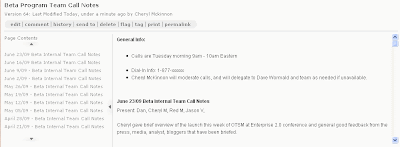
Over the 7 months, about 40 people have been in and out of the weekly calls, depending on their roles and phase of the project. Once a week, a core set of this team got on the phone. And as people join the call, I open up our beta community workspace, go to the wiki for weekly status calls, click 'edit' and go.


While on the phone, the roll call is done, the old business reviewed, action items knocked off, new items added, we recap the status of all the customer beta communities, wrap up with a open discussion on issues or interesting topics. And when we're done, I click "save", and whammo. Instant meeting notes, organized consistently from week to week, categorized by the date and call number, immediately ready for anyone who missed the call, and optionally pushed out as a notification to those who chose to subscribe to updates.

Simple, fast, efficient.

7 months = 28 weekly calls so far, 2.5 action item updates per week x (40 people x 25% on core team) = ~700 emails not sent

Cool, but not the light bulb moment. That moment came a month ago when we got an intern from the university for a summer work term. How to get him up to speed rapidly and accurately to get him productive on Day 1? Easy. Sent 1 URL to the status call wiki, he read from bottom to top and knew what was going on and who the key people were. I actually cannot even imagine how long that would have taken if we would have relied on e-mail communication.


But it was not just the technology that made this work. It was the people - the people who committed to working this way. The core team who led by example. Who posted action items in the community (never underestimate the power of peer pressure to get things done). By delegating the call chair duties by posting a shout-out to the community when travel or vacation made it impossible for me to dial-in. By wanting to all be able to walk the talk in front of our colleagues, partners and customers.

2.0 technology made this easy, it but didn't 'cause' the success. The community workspace and wiki was a tool that made sense for the task - bridging a diverse, distributed global team focused on a shared objective. I haven't even personally met everyone on the team yet. But I know their smiling faces, what they can contribute, and what I've learned from them. My Social Workplace in action.


** OK, the 'almost' no-email beta program. Full disclosure: we used email with colleagues who had a specific role for a narrow portion of the program. Ie, getting the corporate legal OK on any agreements. And for customer communication before they went live. And my comment to my colleagues who subscribed to automated email notifications, well, that was your own choice.

Some good E2Conf recap blog posts so far - (watch the #e2conf twitter stream as more pop up over next few days):
Sameer Patel @ Pretzellogic

Ron Miller @ Fierce Content Management 1 of 2 (argh. I bad hair day, but was fun chat with Ron in the ultimate conference social workplace, the hotel lounge)

Ron Miller @ Fierce Content Management 2 of 2 "Neatest Technology at Enterprise 2.0" And yep... we're there ;-)

Doug Cornelius @ Compliance Building He called out some great reality checks as 2.0 comes into business and faces compliance and governance issues of the real world

What I Learned... @ Mashup Patterns

Social Amber - It's about the people...

E2Conf Blogger Janetti Chon "It's a Wrap"

Monday, May 18, 2009

Haunted by the Box of Rocks

Previously posted at GTEC Blog: http://blog.gtec.ca/?p=352

At GTEC 2008, I presented a seminar called “Managing Corporate Memory in Public Sector”. The well-attended session explored the pending shift in workforce demographics as the Boomer generation approaches retirement age. Sectors at most risk included government, utilities, engineering, transportation and manufacturing. I sought to explore how IT and IM professionals could play a strategic role as our workplace transforms and to minimize risk of information and knowledge loss.


Though this is no longer a new topic challenging public sector management, the situation continues to grow in urgency and awareness. Over the weekend, I noticed that Gartner Research VP, Jeffrey Mann, had twittered about a recent spike in his customer inquiries precisely on this topic. He “tweeted”: “three of this morning’s 4 calls are on knowledge management (two on capturing experience of retiring employees) who says KM is dead?”.


Whether we call it knowledge management, corporate memory preservation, succession planning… whether the project is led by IM/RM, Human Resources or IT… regardless of the tools we use to capture the intrinsic knowledge held in the brains of our most senior valued employees – we know it must be done. Public Sector is a knowledge-economy enterprise. Information, policies, and programs: services are delivered to the citizens, residents, businesses within our jurisdiction to provide a stable infrastructure for social, commercial and political activities. To not pay attention to prospect of losing mentorship, best practices, and institutional culture is to do a disservice to the investment we’ve made in cultivating depth and breadth of public sector experience.

We all have our “keep me up at night” moments. Mine is a story told to me at the annual ARMA Conference in 2006. I was conducting a workshop on this topic of “Managing Corporate Memory” and a woman from an academic institution came up to me, very pleased to see the research I had done on the topic. As part of her Records Management responsibility, she was tasked with capturing the legacy paper and physical records of the scientists and engineers who retired from her institution. She told me the story of a scientist who upon his departure handed to her a large box of ore samples. He said to her very intently, “make sure you hang on to these… they are very very important”. And so she took them. And put them on a shelf, documented with the date and location and name of the scientist who left them behind. She looked at me rather sadly, and admitted that she had no idea what those rocks meant, or WHY they were so important. There was no corporate memory preservation mandate to ensure the samples got to a new researcher who could continue the work. So to this day, they sit on a dark shelf.

Was the cure for cancer in that box of rocks? Did they tell us something about our world that could make our lives better? We may never know.

To learn more about this topic of Managing Corporate Memory, click here to listen to a recorded educational seminar we hosted earlier this year. Any comments or feedback welcomed.