Sunday, August 23, 2009

What Do Law Firms Need to Know About Web 2.0?


It's ILTA week!

Have had some interesting conversations with my colleagues in the Legal Solutions group over the last few months, as we explore the unique requirements of law firms in this new world of 2.0 and Social Media.

In July, we co-hosted a webinar with our ILTA peer group and explored some of these issues and use cases. We'll be building on that session this week at the conference...

Some of the key themes we'll discuss:

  • Next Generation Content Explosion Will Come from Web 2.0 & Social Media: the content forms emerging from the "Web 2.0" world will increasingly supplement (or supplant) more traditional electronic document forms... how will this impact your firm's document management strategy?
  • Social Workplace and Social Marketplace: the core Use Cases for "2.0" fall into 2 high level categories - a firm adopts new technologies to build out a more Social Workplace or a more Social Marketplace. Is the conversation and collaboration requirements focused on better connecting and communicating with colleagues (internal/workplace)? or with contractors, clients or prospects (external/marketplace)?
  • Risk vs. Reward: all new forms of online communication and collaboration have inherent risk AND reward - figuring out the right balance for your firm is the real challenge - so look at a refresh to your overall information governance and appropriate use policies to make sure a useful set of boundaries are set and clearly communicated to users.


If you can't make it to ILTA in person, here are links to the content we'll be discussing:

Slideshare PowerPoint link: http://www.slideshare.net/CherylMcKinnon/what-do-law-firms-need-to-know-about-web-20

Open Text calendar highlights for ILTA event here: ILTA - Events Page (Come see me present the "What Do Law Firms Need to Know About Web 2.0" session at 10:30am on Wednesday August 26!)

Sign up for the Open Text Legal Community of Practice - get the full recorded webinar from July 15, along with a host of other rich resources in our online customer forum here: Open Text Online (Request an account if you're not already a member)

Whitepapers from Open Text - Enterprise 2.0, Building the Social Workplace, Building the Social Marketplace

See you at the Gaylord!

Friday, August 7, 2009

Twitter in Government? Strategy from Across the Pond


Previously posted at GTEC.CA Blog: http://blog.gtec.ca/?p=512

Last week a fascinating and very useful guide to Twitter for Government was published by Neil Williams, head of corporate digital channels at the UK Department for Business, Innovation and Skills. The blog post and full 20 page report linked here: Digital Engagement Blog

While specific to ‘official’ department use of Twitter, even seasoned Twitter users can learn something new about using this increasingly popular micro-blogging communication service.

Four key topics are covered:

1. Objectives and Metrics – why to use it and how to assess value

2. Risks and Mitigation – how contain potential risks to reputation

3. Channel proposition and management – how to populate and use it

4. Promotional plan – how to promote the presence and increase its reach


The document also includes a very useful glossary, providing a great overview of social media and Twitter terms.

What struck me as interesting?

  • Twitter is being incorporated as part of a larger strategy of the UK government to better engage citizens. It provides a low-barrier to entry allowing people to interact with their public institutions and let them experience live coverage of events when they cannot attend in person.
  • The policy offers clear communication on what constitutes inappropriate content, the importance of ‘light’ but effective procedural controls and guidelines for Twitter users, and how to proactively avoid potential ‘hacks’, misrepresentation or vandalism of content.
  • “Tone of Voice” must be considered and articulated to ensure consistency especially when the account is managed by a team (great tip for any public or private sector corporate social media outreach)
  • Content should be varied, have a human touch, be timely, credible and inclusive. The report’s tips on frequency, ‘re-tweeting’, use of hashtags (ie, metadata for Twitter updates), hyperlink shortening tools, how to balance humour and fun – these pointers demonstrate thoughtfulness and a good understanding of how to build and maintain a solid list of followers.
  • UK is thinking longer term – including how Twitter may evolve one day into a new source of intake for Ministerial Correspondence systems – and whether these departmental professionals should begin monitoring and responding to Twitter enquiries.
The fundamental missing piece to this otherwise excellent guideline is articulated very well by Gartner’s Andrea DiMaio in an earlier blog post. What’s not covered is: “whether and how individual government employees should use it to better fulfill their tasks”. In other words, while it is a good guideline to create an institutional presence, it is thin on how and why the people working for that institution can or should use social media channels as part of their job. Perhaps there will be a part 2?

Friday, July 17, 2009

It's 2.0'Clock... Do You Know Where Your Content Is?

(originally published @ GTEC blog: http://blog.gtec.ca/?p=489)

The hot topic this week in the social media world is all about content management. Yes, enterprise content management.

If you haven’t been following the latest news, popular social network/communication company Twitter was the target of some malicious activity this week, with some sensitive corporate documents stolen and circulated to several bloggers. ( Click here for a real-time news round-up) Individual Twitter employees were targeted and the early explanation is that some passwords were compromised. Some bloggers chose to publish the stolen/leaked information, others did not. The sources of the documents were apparently varied: online ‘cloud’ document authoring and storage platforms, mobile accounts, email addresses, and others.

This post isn’t directed at Twitter specifically, nor the individual online/mobile applications that were compromised. But I do question how an organization – whether public or private sector – could risk their sensitive corporate information on any platform not equipped with at least the basics of what we call ECM – document management, records management, retention rules, access controls and audit trails.

What Were They Thinking?

Financial projections, business plans, human resource information and resumes, customer communication: these are the content types now surfacing for public and competitor scrutiny. Organizations who view such information as competitive advantage, as strategic to growth, as evidence of trust with their staff or customers need to walk the talk and make the efforts to protect it appropriately. Access control lists to restrict sensitive data to only certain employees or groups; disposal schedules to safely destroy content that is no longer serving a specific business or regulatory purpose but could only embarrass; audit trails and activity history to know when/where/how content was accessed and by whom: this is content management “101”.

The day we get too caught up in the hip and cool world of web 2.0 and cloud applications that neglect and ignore the basics, is the day the utterly preventable backlash begins, and the progress we’ve made over the last few years towards a more open knowledge sharing culture evaporates.

My advice? Use Twitter, but don’t be like Twitter. Use social media and collaborative tools to share information that is appropriate to share and where sharing benefits your organization, your team and you.

But content that needs protection? That is only your business? That is subject to privacy laws or regulatory scrutiny? That can only harm your organization, your team and you if wrongly shared? Invest in the extra effort to put on the security blanket. The culture of sharing, of knowledge exchange, of openness has its place, but it needs to be balanced with an overall information governance strategy; one that protects organizational interests , intellectual property, and the privacy of its staff, customers, shareholders and partners.

Saturday, June 27, 2009

Making Enterprise 2.0 Real. My Story of the "No E-Mail Beta Program" **

A whirlwind week in Boston as we launched Open Text Social Media to the premier gathering of Enterprise 2.0 thinkers, vendors and practitioners. The downside? I didn't attend nearly as many of the sessions as I had circled in the guide. The upside? Fantastic one-on-one meetings all week with customers, prospects, partners, press, analysts, bloggers. We chatted in meeting rooms, at the Starbucks, in the pub and of course, those comfy couches in the Open Text Lounge.


Still a lot of angst in the E2.0 world about making it real. How do we measure, how do we justify. SHOULD we measure? SHOULD we justify? How to get management buy-in, how to get community engagement.

Well, this week my colleagues & I tried to make it real. Most of the people who stopped by our lounge for a discussion about our new product saw something a little different. No virtual images. No dummy demo servers. No "what you COULD do.."

We spoke about our own personal day-in-the-life: as active production users of our own dogfood. (I know, I know...some colleagues hate that term. Champagne.. coffee... whatever). And we showed sample people, process and content scenarios based on the reality of how we do things.

Sometimes it is the simple story that delivers the lightbulb moment to people who don't quite see the value yet.

For me, it's my story of "The No E-mail Beta". **

In November we announced our 2.0 plans at Open Text Content World, and started recruiting customers interested in beta program participation. From November '08 to early '09, we talked with customers, learned about their potential use cases, their requirements, and narrowed down the list of participants who were keen and committed. The beta participants have been an incredibly rich source of feedback, ideas, and generous with honest and open comments on likes and dislikes.

In December, we kicked off a weekly status call for all of our internal people: development, services, product management and marketing, customer relationship managers, spanning at least 4 countries and likely 8+ cities.

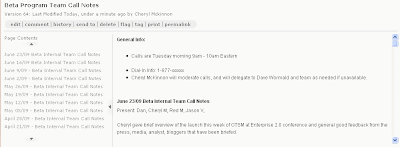
Over the 7 months, about 40 people have been in and out of the weekly calls, depending on their roles and phase of the project. Once a week, a core set of this team got on the phone. And as people join the call, I open up our beta community workspace, go to the wiki for weekly status calls, click 'edit' and go.


While on the phone, the roll call is done, the old business reviewed, action items knocked off, new items added, we recap the status of all the customer beta communities, wrap up with a open discussion on issues or interesting topics. And when we're done, I click "save", and whammo. Instant meeting notes, organized consistently from week to week, categorized by the date and call number, immediately ready for anyone who missed the call, and optionally pushed out as a notification to those who chose to subscribe to updates.

Simple, fast, efficient.

7 months = 28 weekly calls so far, 2.5 action item updates per week x (40 people x 25% on core team) = ~700 emails not sent

Cool, but not the light bulb moment. That moment came a month ago when we got an intern from the university for a summer work term. How to get him up to speed rapidly and accurately to get him productive on Day 1? Easy. Sent 1 URL to the status call wiki, he read from bottom to top and knew what was going on and who the key people were. I actually cannot even imagine how long that would have taken if we would have relied on e-mail communication.


But it was not just the technology that made this work. It was the people - the people who committed to working this way. The core team who led by example. Who posted action items in the community (never underestimate the power of peer pressure to get things done). By delegating the call chair duties by posting a shout-out to the community when travel or vacation made it impossible for me to dial-in. By wanting to all be able to walk the talk in front of our colleagues, partners and customers.

2.0 technology made this easy, it but didn't 'cause' the success. The community workspace and wiki was a tool that made sense for the task - bridging a diverse, distributed global team focused on a shared objective. I haven't even personally met everyone on the team yet. But I know their smiling faces, what they can contribute, and what I've learned from them. My Social Workplace in action.


** OK, the 'almost' no-email beta program. Full disclosure: we used email with colleagues who had a specific role for a narrow portion of the program. Ie, getting the corporate legal OK on any agreements. And for customer communication before they went live. And my comment to my colleagues who subscribed to automated email notifications, well, that was your own choice.

Some good E2Conf recap blog posts so far - (watch the #e2conf twitter stream as more pop up over next few days):
Sameer Patel @ Pretzellogic

Ron Miller @ Fierce Content Management 1 of 2 (argh. I bad hair day, but was fun chat with Ron in the ultimate conference social workplace, the hotel lounge)

Ron Miller @ Fierce Content Management 2 of 2 "Neatest Technology at Enterprise 2.0" And yep... we're there ;-)

Doug Cornelius @ Compliance Building He called out some great reality checks as 2.0 comes into business and faces compliance and governance issues of the real world

What I Learned... @ Mashup Patterns

Social Amber - It's about the people...

E2Conf Blogger Janetti Chon "It's a Wrap"

Tuesday, June 23, 2009

Open Text Social Media says "Hello World" - June 23 2009

Today we launched the new Open Text Social Media offering... helping organizations bloom into a new world of productivity and connectedness. This has been one of the coolest projects I've worked in my ECM career.

We're at the Enterprise 2.0 conference in Boston June 22-25. If you're around, come see us at Booth 615. If you're not, checkout the Twitter stream at #e2conf http://search.twitter.com/search?q=e2conf

Announcement here: http://www.opentext.com/2/global/press-release-details.html?id=2220


Sunday, June 21, 2009

Putting Passive on the Not-Hot List for 2010

TV, radio, movies, and music created by the few for the mass audience: the rise of content consumption as a passive exercise is a 20th century phenomenon.

If we go back a century, the way that we received and consumed content for leisure and business was by definition social: through the lecture, the recital, the sermon, the town hall meeting. It was people communicating directly with people. The opportunity to interact, question, or offer feedback in the form of applause or catcalls permitted immediately brought a connection between content producer and content consumer.

Mass communication facilitated by radio, TV, commercial movie studios or multinational publishing empires introduced a disconnect in the so-called modern era. A disconnect between the content producer and its consumers.

The rise of the participatory web - an outcome of the 2.0 phenomenon over the last few years - is changing this.

At the recent Gartner Portals Content & Collaboration Conference, I was fortunate to pick up a copy of "CrowdSourcing" written by Jeff Howe of Wired Magazine. It was gratifying to hear some reinforcing opinions - that passive consumption of mass produced content is increasingly becoming passé; as Howe says, "the explosive growth in user-generated content is less a new phenomenon than a sign that the impulse to interact meaningfully with our own media - to participate in its creation - never went away".

When we think about the work that we produce as information workers, we need to consider engaging our intended audience. That we not fall into the trap of being one-way push machines of mediocre mass-produced content. As Web 2.0 technologies come into the workplace, we need to expect to have our content read, rated, re-used, linked, re-tweeted, tagged and commented upon. Our audience - whether internal colleagues or external consumers - will feel freer to offer feedback as the tools permit.

Are we creating content that is so valuable that it will be linked to? forwarded? aggregated? quoted from? Social media forms lend themselves very well to the metrics and measurements of engagement. Active engagement can be measured and creates additional value to the original work via edits, comments, recommendations and aggregation.

Passive push of a slide deck in an email to one person when everyone could benefit is "Not Hot". Posting the same content in an interactive, linkable web community site where interested eyeballs can engage with it is.

Wednesday, June 3, 2009

What Do Records Managers Need to Know About Web 2.0?

This has become one of my pet research topics over the last 2 years. I've been invited to present this topic now in front of at least six ARMA chapters, a couple of AIIM events, four or five public sector conferences, the RMAA annual conference in Australia ...not to mention annoying my Records and Archiving "aspirin" colleagues with my endless fist-pounding cafeteria rants.

I keep promising @JesseWilkins that I'll put up a slideshare version of my ever-evolving deck, but in the meantime, here's where you can get to some of the key content:

June 2009: Discussion on US Federal News Radio "Daily Debrief Show":June 3, 2009 Federal News Radio MP3 Link

Slide Deck: From April 2009 Ontario Public Sector Information Management Conference: What do Records Managers Need to Know About Web 2.0


KM World Whitepaper from Fall 2008 (sign up required... free download): KM World Whitepaper Dec 2008


Legaltech NYC Keynote recap, January 2009 "Think Left" from ECM Briefs

RMAA Keynote Recap, September 2008, "What's Hot with Records Managers in Australia"? from ECM Briefs

2008 Podcast with Information Architected @Dan Keldsen, Records Management Product Marketing Goddess Liz Kofsky & me: ECM Briefs - link to podcast

I'll keep updating this resource list as content is published and updated.